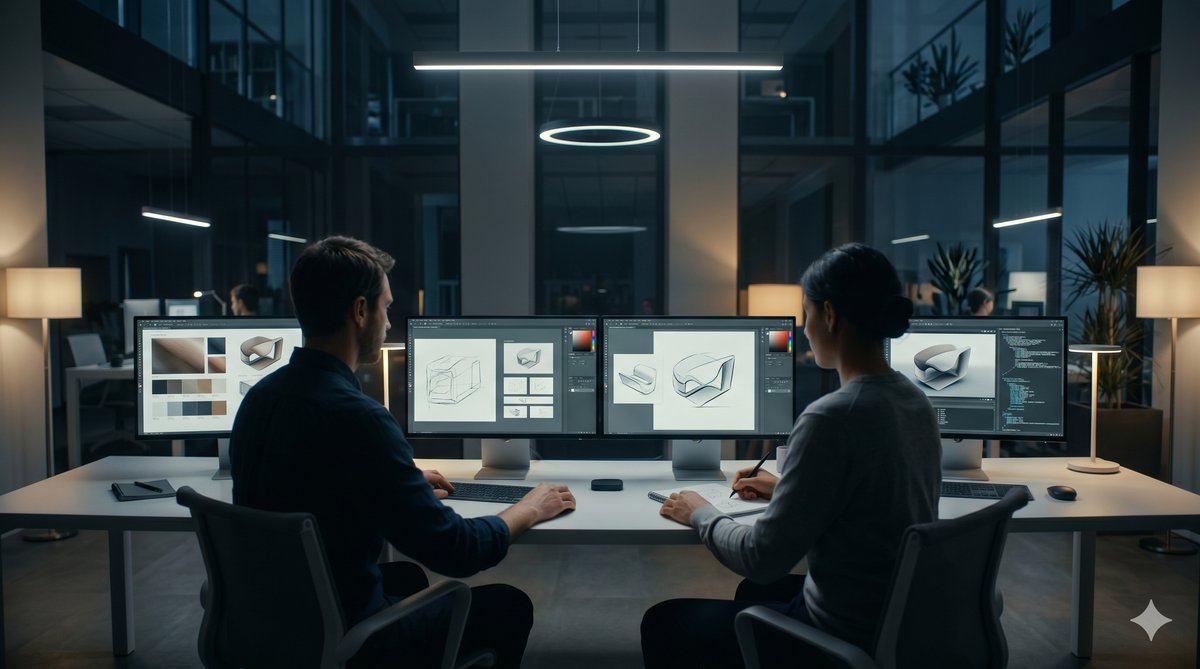
Over the past two years, I've watched AI move from a curiosity at the edges of design practice to something sitting squarely in the middle of how teams actually work. Not in the dramatic "AI will replace designers" way the headlines love, but in quieter, more interesting ways that are fundamentally changing what the job looks like day-to-day.
Discovery is getting faster — and messier
The biggest shift I've seen is in research synthesis. What used to take days — pulling themes from user interviews, tagging observations, building affinity maps — can now happen in hours with the right AI tooling. That sounds purely positive, but it introduces a new risk: speed can create false confidence.
When synthesis is slow, designers tend to sit with the data longer. They notice the outlier, the contradiction, the quote that doesn't fit neatly. When it's fast, there's a temptation to accept the AI's clusters as truth and move on. The craft of discovery is increasingly about knowing when to push back on what the AI surfaced — not just using it uncritically.
The designers I see thriving with AI aren't the ones using it to do more, faster. They're the ones using it to get out of the weeds so they can think harder about the right questions.
Ideation has a new shape
AI has made the divergent phase of design almost frictionless. You can generate fifty interaction variations, a dozen visual directions, or a set of user journey alternatives in the time it used to take to sketch out three. For experienced designers, this is genuinely useful — it removes the blank-page paralysis and surfaces options you might not have considered.
The challenge is that it also flattens the quality curve. When everything is easy to generate, the ability to evaluate and curate becomes the real skill. Teams that haven't developed strong critique culture are finding themselves drowning in acceptable outputs, unable to identify the truly good ones.
Prototyping and delivery are converging
The gap between "this is a prototype" and "this could ship" is narrowing quickly. AI-assisted code generation means that a high-fidelity interaction prototype can be turned into production-ready components much faster than before. For product designers working closely with engineers, this is creating exciting new collaboration patterns.
But it's also creating new tensions. When the bar for "good enough to test" drops, there's pressure to skip validation steps. The logic goes: "We can just build it and see." That's sometimes the right call — but often it's a way of avoiding the harder thinking that upfront research and prototyping forces you to do.
What this means for how I work with teams
When I help teams integrate AI into their design process, I'm increasingly focused on three things:
- Building evaluation muscle. If AI handles generation, the human skill that matters most is judgment. Teams need to invest in critique, in standards, in the ability to say "this isn't good enough" — and explain why.
- Protecting the slow work. Some parts of design — sitting with a user, wrestling with a constraint, arguing over a decision — shouldn't be sped up. Identifying those and guarding them is as important as knowing where to apply AI.
- Making AI decisions visible. When an AI helped shape a design decision, that should be traceable. Not because AI is suspect, but because teams need to understand their own process to improve it.
AI is making design practice more interesting, not less. But "interesting" isn't the same as "easier." The teams that will do the best work in the next few years are the ones building the judgment and culture to use these tools well — not just the ones using them most.